
A Practical Guide to Yacht Charter Booking Software in Dubai
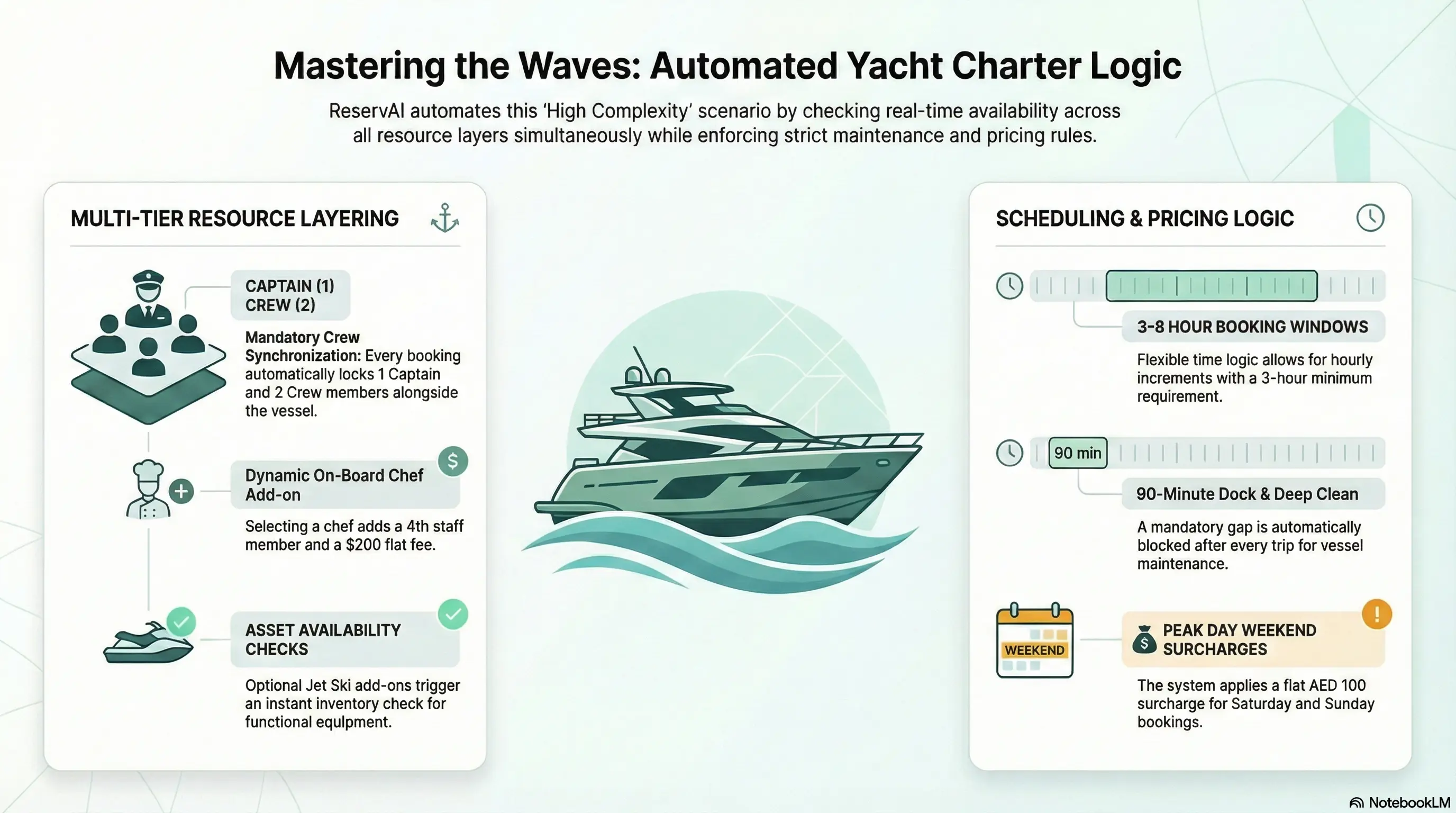
A customer booking a yacht sees a vessel, a date, a duration and a price. The operator sees everything required to deliver that charter safely and professionally.
The vessel must be available. The appropriate crew must be assigned. Optional equipment cannot already be promised elsewhere. Enough time must remain for cleaning, inspection, refuelling and preparation before the next departure.
When these details live in separate calendars, spreadsheets and WhatsApp conversations, accepting a booking becomes a manual coordination exercise.
Yacht charter booking software should bring the commercial booking and operational availability into one dependable workflow. This guide explains what Dubai charter operators should look for and where general booking software ends and maritime compliance begins.
Booking software does not replace maritime authorisation
Before discussing software, it is important to separate scheduling from regulatory compliance.
Dubai’s vessel-chartering regulations require operators to obtain the relevant authorisation. Published requirements include a valid commercial licence, approval relating to the operating and berthing area, vessel licences and crew permits.
The exact obligations depend on the activity, vessel and current regulatory framework. Operators should verify requirements directly with the relevant Dubai maritime authorities before offering charters.
Review the Dubai legislation regulating vessel-chartering activity and current Dubai Maritime Authority service guidance.
Booking software can help prevent scheduling conflicts and maintain commercial records. It does not issue permits, certify crew, inspect vessels or determine whether a charter is legally permitted.
This article provides operational guidance, not legal or maritime-safety advice.
Treat every vessel as an individual resource
A yacht is not simply one unit from a generic inventory count. Each vessel has its own capacity, location, availability, pricing and operating requirements.
The booking system should therefore record and schedule the specific vessel being chartered.
For every yacht, consider configuring:
- The vessel’s public name and description.
- Its normal charter duration options.
- Passenger-capacity information.
- Its berth or operating location.
- Hourly or daily pricing.
- Normal operating availability.
- Unavailable maintenance periods.
- Preparation time required after each charter.
- Services and add-ons compatible with that vessel.
When a customer reserves a particular yacht, that vessel should become unavailable for conflicting bookings across every service that depends on it.
This only works when all booking channels share the same availability. A charter accepted through WhatsApp or by an agent must block the vessel in the same system used by the online booking page.
Schedule crew availability without confusing it with compliance
A confirmed vessel is not automatically an operationally ready charter. The appropriate crew must also be available.
A resource-aware booking system can associate staff with a charter and prevent the same person from being scheduled for conflicting work.
Depending on the operator’s approved procedures, resources might include:
- The captain or master.
- Required crew members.
- Hospitality staff.
- A chef requested for a particular experience.
- Specialist personnel for an approved activity.
Avoid hard-coding a generic rule such as “one captain and two crew members” across the fleet. The correct crewing arrangement depends on the vessel and applicable operational requirements.
The booking platform can answer, “Is the assigned person available?” It should not be relied upon to answer, “Is this person’s maritime qualification valid for this vessel and activity?” unless it includes a dedicated, maintained credential-management function.
Operators should maintain a separate process for checking permit validity, qualifications, expiry dates and other compliance records.
Manage charter add-ons as real operational commitments
Add-ons can improve the customer experience, but they are not merely extra lines on an invoice.
Each add-on may affect:
- The charter price.
- Preparation time.
- Required staff.
- Equipment availability.
- Vessel capacity.
- Supplier coordination.
- Regulatory or safety requirements.
Catering and private-chef services
A catering package may only change the price and preparation process. A private-chef service may also require an available staff member or external supplier.
If a chef is a limited resource, the booking system should check availability before allowing the customer to confirm that option.
Water-sports equipment
A jet ski or other limited asset should not be promised to two charters at the same time. The equipment can be connected to the add-on so that selecting it reserves the relevant asset.
However, availability is only one part of the decision. Operators must separately confirm that the equipment, activity, personnel and operating area satisfy current licensing and safety requirements.
Decorations, events and celebrations
Event packages may require additional preparation time, supplier access or restrictions on the types of decorations permitted on the vessel.
Describe exactly what is included and avoid allowing customers to assume that every request can be accommodated automatically.
Use pricing rules customers can understand
Yacht pricing can vary according to vessel, duration, date, time and selected experience.
A booking system may need to combine:
- A base hourly or daily rate.
- A minimum charter duration.
- Peak-date or peak-time adjustments.
- Additional hours.
- Catering or hospitality packages.
- Equipment add-ons.
- Applicable deposits or payment schedules.
Reservai supports fixed or percentage-based price modifiers on configured availability schedules. This can be used to apply different pricing during defined periods.
Avoid arbitrary rules that do not reflect the operator’s actual demand. A universal AED 100 weekend surcharge, for example, may be too low for one vessel and unsuitable for another.
Build pricing from operating data:
- Which dates and departure times consistently fill first?
- Which vessels have the strongest demand?
- Which add-ons create extra work or supplier costs?
- How does a longer charter affect the next available departure?
- Which payment arrangements create additional financial risk?
The customer should see an understandable total before confirming. If a request requires manual approval, present it as an enquiry or provisional quote instead of an instant confirmed booking.
Protect turnaround time between charters
The period after one charter and before the next is part of the operation.
It may be needed for:
- Guest disembarkation.
- Cleaning and resetting guest areas.
- Refuelling where required.
- Restocking refreshments and amenities.
- Checking equipment.
- Recording damage or maintenance concerns.
- Crew preparation and briefing.
- Preparing approved add-ons for the next customer.
The correct buffer is not universally 90 minutes. It should reflect the vessel, charter type, berth procedures and operator’s own safety and service standards.
A configured post-booking buffer prevents customers from selecting a departure time before the vessel and relevant resources are ready again.
This is different from a maintenance-management system. A booking buffer protects time in the calendar; it does not confirm that an inspection occurred or that a technical issue was resolved.
Capture the details needed before departure
The booking journey should collect enough information to prepare the charter without overwhelming the customer.
Depending on the experience, the operator may need:
- The lead customer’s contact details.
- The requested date and departure time.
- The charter duration.
- The number of guests.
- Selected add-ons.
- Celebration or event information.
- Relevant accessibility requests.
- Customer notes.
- Agreement to booking and cancellation terms.
Any identity, passenger or regulatory information required for the voyage should be handled according to the operator’s approved procedures and applicable privacy obligations.
A booking platform should not collect sensitive information simply because a form field is available. Collect what is necessary, explain why it is needed and control who can access it.
Make deposits and cancellation terms explicit
A high-value charter may require a deposit or full advance payment to secure the vessel and crew.
The customer should understand:
- The amount due during booking.
- When the remaining balance is payable.
- Whether the booking is immediately confirmed or still requires review.
- The cancellation deadline.
- How weather-related decisions are handled.
- What happens when the customer arrives late.
- How damage deposits or additional charges are treated, where applicable.
These policies should be reviewed professionally and aligned with the operator’s legal and insurance obligations. Booking software can display and record the selected commercial terms, but it does not decide whether those terms are legally sufficient.
Reservai supports different payment arrangements, including deposits, online card payments and approved pay-later methods. Reservai Payments lets eligible UAE businesses accept cards without connecting their own separate gateway.
Verification, commission, processing charges and payout requirements still apply.
Give customers a direct route to book
A charter operator may receive enquiries from its website, Instagram, Google, WhatsApp, hotel partners and other agents.
The online booking journey can be offered through:
- A standalone charter page.
- An individual service widget embedded on the operator’s website.
- A fleet or services widget.
- A direct booking link shared in conversations.
The customer should be able to understand the vessel, duration, price, inclusions and payment requirement without repeatedly asking for basic information.
Direct online booking does not mean every request must be approved automatically. High-value, unusual or compliance-sensitive requests can still be routed through a manual review process.
Maintain a dependable booking record
A yacht charter may change after the first reservation. The customer might extend the duration, add catering or change the number of guests.
The booking record should show:
- The yacht selected.
- The original and amended date or time.
- The charter duration.
- Assigned resources.
- Selected add-ons.
- The quoted price.
- Payments received and amounts still due.
- Customer notes.
- Cancellations, amendments or refunds.
This gives the operations team, customer-service staff and financial team a shared reference. It also reduces misunderstandings when the service description or public pricing changes later.
What yacht charter booking software should include
Before choosing a platform, check whether it can:
- Schedule each yacht as a unique resource.
- Prevent vessel conflicts across multiple services.
- Associate crew and other required resources with a charter.
- Reserve limited equipment when an add-on is selected.
- Support hourly or daily pricing.
- Apply defined peak-time price modifiers.
- Reserve turnaround buffers.
- Handle deposits and different payment arrangements.
- Maintain clear booking and payment records.
- Offer a standalone booking page and website widgets.
- Support amendments, cancellations and refunds.
- Scale across additional vessels, staff and branches.
Also identify what the platform does not provide. General booking software may not include maritime compliance management, technical maintenance logs, live GPS tracking, charter contracts, supplier management or crew-certification alerts.
If those functions are essential, confirm whether integrations or additional specialist systems are required.
Where Reservai fits
Reservai can support yacht and boat charter operators that need to coordinate vessel availability with crew, equipment, add-ons, pricing schedules and payments.
Each vessel can be managed as a bookable resource. Additional services can reserve their own required resources, helping prevent the same limited equipment from being allocated to conflicting charters.
Operators can also configure hourly or daily services, post-booking buffers and fixed or percentage pricing adjustments during defined periods.
Reservai is not a maritime licensing, crew-certification or vessel-maintenance platform. Those responsibilities remain with the operator and the appropriate specialist or government systems.
Learn more about Reservai yacht booking software for UAE charter operators.
Frequently asked questions
Can yacht booking software prevent double-booking?
Yes, when the specific vessel is configured as a required resource and every confirmed charter is recorded in the same availability system.
Can Reservai manage yacht crew?
Reservai can include staff availability in the resource requirements for a booking. It should not be treated as a maritime credential, qualification or crew-permit management system.
Can charter prices change for peak periods?
Reservai supports fixed and percentage price modifiers on configured schedules. Operators should build peak pricing from actual demand and costs rather than applying arbitrary surcharges.
Can customers book equipment and catering?
Additional services can change the price and reserve required resources. Operators remain responsible for confirming that any activity, equipment or supplier meets relevant operational and regulatory requirements.
Do charter operators need their own payment gateway?
Reservai Payments can process eligible card bookings without requiring the operator to connect a separate gateway. Verification, commission, processing fees and payout requirements apply.
Does booking software handle maritime permits?
No. The operator must obtain and maintain the licences, vessel permissions, crew permits and other approvals required for its activities.
Make the confirmed booking operationally credible
A luxury booking experience is not created by extravagant language. It is created when the vessel, crew, equipment, price, preparation time and payment terms all match what the customer has been promised.
The right booking system should make those dependencies visible and prevent avoidable conflicts. Compliance, vessel safety and qualified operational judgment must remain outside the marketing promise and under the operator’s control.